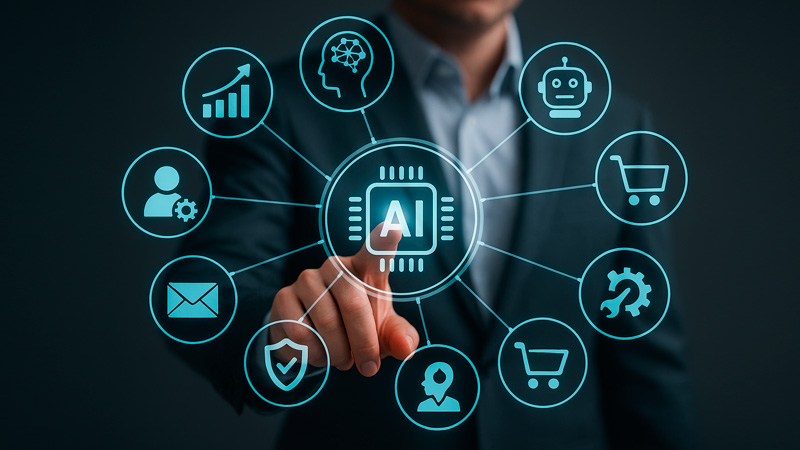
Artificial intelligence is rapidly becoming part of everyday business operations. Companies are using AI to automate repetitive work, improve customer experiences, analyze information, support employees, and make faster decisions. However, adopting individual AI tools without a clear plan can create disconnected systems, unnecessary costs, and limited business value. An AI integration strategy provides a structured approach for connecting artificial intelligence with business goals, existing technologies, workflows, and customer needs.
In 2026, the focus is moving beyond experimenting with AI toward integrating it into real business processes. Current research and industry discussion increasingly emphasize connecting AI investments with measurable business outcomes rather than treating AI as an isolated technology project.
What Is an AI Integration Strategy?
An AI integration strategy is a structured plan for identifying where artificial intelligence can create value and determining how AI should be connected with existing business systems and processes. It covers business objectives, technology selection, data, workflows, security, implementation, measurement, and future scalability.
Instead of asking, “Which AI tool should we buy?” businesses should first ask, “Which business problem can AI solve?” This change in approach helps organizations focus their investments on practical opportunities.
Why Businesses Need an AI Integration Strategy
AI can support many departments, but not every process requires artificial intelligence. Without a clear strategy, businesses may purchase multiple tools that do not communicate with one another or solve important problems.
A structured strategy helps businesses prioritize high-value opportunities, reduce unnecessary technology costs, improve operational efficiency, and create a clearer path from experimentation to implementation. It also makes it easier for management teams to measure whether AI projects are actually delivering business value.
Start With Business Goals
The first step is to define the business outcome you want to achieve. AI should support a specific objective rather than becoming a technology project without a clear purpose.
A business might want to reduce customer-support response times, automate lead qualification, improve sales forecasting, personalize marketing, process documents faster, or reduce repetitive administrative work.
Once the desired outcome is clear, it becomes easier to identify the AI capabilities and integrations required to achieve it.
Identify the Best AI Use Cases
After defining business goals, review existing workflows and identify processes where AI could provide measurable improvements. Strong candidates are often repetitive, data-heavy, time-consuming, or dependent on processing large amounts of information.
For example, a company could integrate AI into customer support to classify inquiries, generate responses, and route complex requests to human representatives. A marketing team could use AI to analyze campaign data and identify customer segments, while a sales department could use AI to prioritize leads.
The objective should be meaningful improvement rather than adding AI to every workflow.
Evaluate Your Existing Technology
AI integration usually works best when it connects with systems the business already uses. Before implementation, companies should review their existing CRM, website, databases, communication platforms, marketing systems, ERP software, and internal applications.
This technology assessment identifies where AI can be integrated directly and where additional APIs, middleware, or custom development may be required.
A connected technology environment can turn AI from a standalone assistant into part of an operational workflow.
Prepare and Organize Business Data
Data is one of the most important foundations of successful AI integration. Businesses need to understand what data they have, where it is stored, who can access it, and whether it is accurate enough for the intended application.
Poor-quality, outdated, or fragmented data can reduce the usefulness of AI systems. Businesses should therefore establish appropriate data management, access controls, security procedures, and governance before expanding AI across multiple workflows.
Choose the Right AI Technology
Different business problems require different AI technologies. Some organizations may need generative AI applications, while others may benefit more from predictive analytics, machine learning models, AI chatbots, recommendation systems, or intelligent workflow automation.
The decision should be based on the business requirement, available data, existing infrastructure, integration requirements, security considerations, and expected return on investment.
The most sophisticated AI technology is not always the best option. A simpler solution that reliably solves a business problem can create more value.
Integrate AI With Existing Workflows
AI should be connected to the systems where employees and customers already work. For example, an AI chatbot can connect to a CRM to capture leads, retrieve customer information, and transfer qualified prospects to a sales team.
Similarly, an AI automation workflow can receive information from a website, process it with an AI model, update a database, and notify an employee.
This type of integration creates an end-to-end process instead of forcing employees to switch between disconnected applications.
Start Small and Scale Gradually
Businesses should avoid attempting a complete AI transformation in a single step. Starting with a focused pilot allows teams to test the technology, evaluate results, identify problems, and improve the workflow before expanding it.
A successful pilot can then become a repeatable model for additional departments and processes.
This approach also makes AI investments easier to manage because businesses can evaluate actual results before committing significant resources to larger implementations.
Measure AI Integration ROI
Every AI project should have measurable success criteria. Depending on the use case, businesses can evaluate time saved, cost reduction, response speed, conversion rates, productivity, customer satisfaction, or revenue impact.
Measuring results helps organizations determine which AI projects deserve additional investment and which workflows need improvement.
The goal should be business value, not simply the number of AI tools deployed.
Prioritize Security and Human Oversight
AI integration should include appropriate security and governance from the beginning. Businesses need to consider data privacy, system permissions, sensitive information, model accuracy, and human review.
Human oversight can remain particularly important when AI systems influence decisions involving customers, finances, compliance, or other sensitive business processes.
Responsible implementation helps organizations benefit from AI while maintaining control over important business operations.
Build an AI Strategy That Can Scale
A modern AI integration strategy should be designed for future expansion. Businesses should consider whether new AI applications can connect with their existing infrastructure and whether successful workflows can be reused across departments.
This is especially important as AI agents and increasingly autonomous systems become more capable of interacting with multiple applications and completing multi-step workflows. Research into agentic AI emphasizes the importance of clear ownership, business-domain knowledge, human oversight, and integration with existing organizational processes.
AI Integration for Marketing and Customer Experience
AI integration can create significant opportunities for marketing and customer experience. Businesses can connect AI with CRM systems, websites, advertising platforms, email marketing systems, and analytics tools.
These integrations can support lead qualification, customer segmentation, personalized communication, campaign analysis, automated follow-ups, and customer support.
For businesses investing in digital marketing, AI integration can therefore connect marketing activities with sales and customer-service workflows.
AI Integration and the Future of Search
AI integration is also becoming relevant to digital visibility. Google introduced dedicated Search Console reporting for visibility from generative AI features such as AI Overviews and AI Mode in 2026, showing how AI-powered search is becoming an increasingly measurable part of search visibility.
However, businesses should not treat AI search as a replacement for traditional SEO. Google’s current guidance says strong SEO fundamentals remain important and recommends creating unique, useful, reliable, people-first content rather than producing large amounts of generic AI content.
Common AI Integration Mistakes
Businesses can struggle with AI when they focus on technology before understanding the problem. Other common mistakes include using disconnected tools, ignoring data quality, failing to establish security controls, skipping testing, and measuring activity instead of business outcomes.
A successful AI integration strategy keeps the business objective at the center of every technology decision.
How QSSols Can Help With AI Integration
QSSols provides AI, automation, web development, and digital marketing solutions designed to help businesses connect technology with practical business requirements. AI integration can be used to improve workflows, automate repetitive processes, support customer interactions, and create scalable digital systems.
For businesses evaluating AI adoption, the best starting point is to identify a high-value business problem, assess the existing technology environment, and develop a practical integration roadmap before selecting or building the solution.
Conclusion
An AI integration strategy gives businesses a structured way to move from AI experimentation to measurable business value. Instead of adopting technology simply because it is available, companies can identify valuable use cases, prepare their data, connect AI with existing systems, test focused implementations, measure results, and gradually scale successful solutions.
The future of business AI will not be defined only by which companies use artificial intelligence. It will be defined by how effectively they integrate AI into real workflows, customer experiences, and strategic decision-making.
Businesses that approach AI integration as a long-term capability rather than a collection of disconnected tools can build a stronger foundation for efficiency, innovation, and sustainable growth.