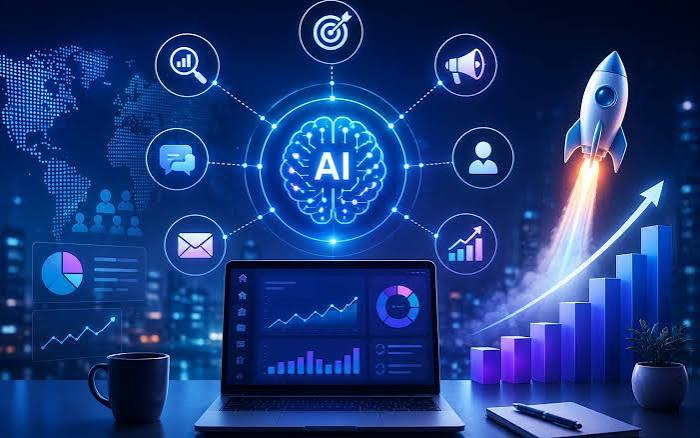
Artificial intelligence is changing how businesses approach growth marketing. Instead of relying entirely on manual campaign management, marketers can now use AI to analyze customer behavior, identify opportunities, personalize experiences, automate repetitive activities, and improve marketing decisions.
In 2026, the opportunity is moving beyond simply adding AI-generated content to a marketing plan. Businesses can use AI across the entire growth cycle, from customer acquisition and lead qualification to conversion optimization, retention, and marketing analytics. Google continues to expand AI capabilities across advertising, audience discovery, creative development, analytics, and measurement, demonstrating how deeply AI is becoming integrated into modern marketing systems.
What Is AI Growth Marketing?
AI growth marketing combines growth-focused marketing principles with artificial intelligence and automation. The objective is to identify opportunities for acquiring customers, increasing conversions, improving retention, and maximizing customer value.
Traditional growth marketing often depends on experimentation and manual analysis. AI can accelerate these activities by processing large amounts of information, identifying patterns, generating campaign variations, and helping marketers determine which opportunities deserve attention.
The important distinction is that AI should support the growth strategy rather than become the strategy itself.
Start With a Clear Growth Objective
Before introducing AI, businesses should determine what they are trying to improve.
A company may want more qualified leads, lower customer acquisition costs, higher website conversion rates, increased online sales, stronger customer retention, or greater customer lifetime value.
Once the objective is clear, AI can be applied to the parts of the marketing funnel most likely to influence that outcome.
For example, a business struggling with low conversions may benefit more from AI-assisted customer analysis and personalization than from simply generating more content.
Use AI to Understand Your Customers
Growth begins with understanding who is most likely to become a valuable customer.
AI can analyze information from CRM systems, website interactions, purchase history, advertising campaigns, customer-support conversations, and other permitted data sources to identify behavioral patterns.
This can help businesses discover which customers are most engaged, which products or services attract particular audiences, and which behaviors may indicate purchase intent.
The result can be more focused marketing rather than spending the same resources on every potential customer.
Create AI-Powered Customer Segments
Customer segmentation is a major opportunity for AI growth marketing.
Instead of relying only on basic demographic categories, businesses can create segments based on behavior, engagement, purchase frequency, interests, customer value, and interactions with the brand.
For example, an e-commerce company could distinguish between first-time visitors, high-value repeat customers, inactive customers, customers showing strong purchase intent, and customers interested in specific product categories.
Each group can then receive a different marketing experience.
Google’s advertising developments for 2026 emphasize AI-powered audience discovery and the use of first-party data to help advertisers reach relevant customers across different experiences.
Use AI to Improve Customer Acquisition
AI can help businesses identify potential customers more efficiently.
Advertising platforms increasingly use AI to optimize targeting, bidding, creative combinations, and campaign delivery. Businesses can provide the system with reliable conversion signals and clear objectives while allowing algorithms to identify patterns in campaign performance.
However, automation should not replace strategic campaign management. Businesses still need appropriate offers, accurate conversion tracking, quality creative assets, and a strong understanding of their target audience.
Build AI-Assisted Content Marketing
Content remains an important part of growth marketing, but AI can help make the process more efficient.
Marketers can use AI for topic research, content ideation, outlines, content repurposing, audience analysis, editing, and performance evaluation.
The focus should remain on producing genuinely useful content. Google’s guidance emphasizes people-first content that provides original value rather than mass-produced content created primarily to manipulate search rankings.
Businesses should combine AI efficiency with human expertise, original research, practical examples, and a distinctive brand perspective.
Optimize Content for AI Search
Search is becoming increasingly conversational as customers use AI-powered search experiences to research products, services, and companies.
Businesses should therefore create content that clearly answers customer questions and demonstrates expertise around important topics.
Google states that its AI search experiences continue to rely on core Search principles, including technical accessibility, useful content, and established SEO fundamentals.
An AI growth strategy should therefore combine traditional SEO with content designed to provide clear, comprehensive answers to real customer questions.
Use AI for Conversion Rate Optimization
Driving more traffic is not enough if visitors do not convert.
AI can help businesses analyze website behavior, identify potential conversion barriers, compare customer journeys, and generate ideas for improving landing pages.
Businesses can test different headlines, offers, layouts, calls to action, forms, and messaging while using analytics to determine which changes improve performance.
The key is to treat AI as a tool for generating and evaluating hypotheses rather than assuming that every AI recommendation will be correct.
Personalize Marketing Experiences
Personalization can make marketing more relevant to individual customers.
AI can help businesses determine which message, product recommendation, offer, or piece of content may be most relevant based on customer behavior and context.
For example, an online store can recommend products based on browsing and purchase activity. A SaaS company can adapt onboarding communication based on how a customer uses the product.
Effective personalization should provide genuine value rather than simply making customers feel tracked.
Automate Lead Qualification
AI can help sales and marketing teams process large numbers of incoming leads.
A potential customer can submit a website form, after which an AI workflow analyzes the information, identifies the customer’s likely requirements, assigns a qualification score, updates the CRM, and routes the lead to the appropriate salesperson.
This can reduce the time between lead submission and sales follow-up.
It also allows sales teams to focus more attention on leads that require human interaction.
Use AI for Marketing Automation
AI growth marketing becomes more powerful when it is connected to automated workflows.
Marketing teams can automate lead nurturing, email personalization, customer segmentation, reporting, campaign monitoring, and follow-up activities.
For example, a lead that downloads a resource can enter an automated sequence. AI can analyze engagement and help determine which message should be delivered next.
This creates a marketing system that can respond to customer behavior rather than relying entirely on fixed schedules.
Improve Paid Advertising With AI
AI-powered advertising platforms can automate parts of campaign optimization, audience discovery, creative testing, bidding, and measurement.
Google’s 2026 advertising updates show how AI is becoming integrated across campaign planning, audience discovery, creative production, and measurement.
Businesses should focus on providing high-quality conversion data and strong creative assets while maintaining clear campaign objectives.
AI optimization works best when the underlying marketing strategy and tracking infrastructure are reliable.
Use Predictive Analytics for Growth Decisions
AI can help marketers identify patterns that may indicate future customer behavior.
Predictive models can support activities such as identifying customers likely to purchase, estimating churn risk, predicting demand, and identifying high-value customer segments.
These predictions should be treated as signals rather than guarantees.
Marketing teams should compare predictions against actual outcomes and continuously refine their models and strategies.
Improve Customer Retention With AI
Acquiring customers is only one part of growth. Retaining existing customers can have a significant impact on long-term business performance.
AI can analyze customer engagement and identify behavioral changes that may indicate declining interest.
For example, a subscription business might identify customers whose usage has decreased and automatically trigger an appropriate retention campaign.
A human team can then intervene when a customer requires personal attention.
Build an AI-Powered Growth Funnel
A modern growth funnel can connect several AI capabilities.
A customer may discover a business through search or advertising. AI helps identify the relevant audience and optimize campaign delivery. The visitor reaches a personalized landing page. Once the visitor submits a lead form, AI qualifies the lead and updates the CRM. Automated nurturing continues until the customer is ready for sales.
After conversion, AI can support personalization, customer retention, recommendations, and lifetime-value analysis.
This creates a connected growth system rather than isolated marketing campaigns.
Measure Growth With the Right Metrics
AI growth marketing should be measured through business outcomes.
Important metrics may include customer acquisition cost, conversion rate, qualified leads, return on advertising spend, customer lifetime value, retention rate, revenue per customer, and marketing-generated revenue.
Businesses should also measure operational improvements such as hours saved, faster lead response, and reduced reporting effort.
The purpose of AI is to improve business performance, not simply increase the number of automated marketing activities.
Experiment Faster With AI
Growth marketing depends heavily on experimentation.
AI can help marketers generate multiple hypotheses, create campaign variations, analyze results, and identify patterns faster.
For example, a business could test several landing-page messages, advertising concepts, email subject lines, or offers and use performance data to determine which direction deserves additional investment.
However, experiments still need proper testing methodology. Businesses should avoid assuming that a correlation automatically proves that one marketing change caused an improvement.
Keep Human Strategy at the Center
AI can analyze data and automate activities, but humans remain responsible for positioning, brand strategy, creative direction, customer relationships, and major business decisions.
The strongest growth teams combine AI’s speed and analytical capabilities with human understanding of the market and customers.
This is especially important when AI-generated recommendations conflict with brand positioning or broader business objectives.
Create a Reliable Data Foundation
AI growth marketing depends on trustworthy data.
Businesses should ensure that website analytics, CRM information, advertising conversions, customer records, and other important data sources are properly configured and connected.
Poor tracking can cause AI systems to optimize toward the wrong outcomes.
Before investing heavily in AI marketing, businesses should therefore audit their analytics and conversion infrastructure.
Protect Customer Data
AI-powered marketing can involve significant amounts of customer information. Businesses should establish clear rules for data collection, storage, access, processing, and retention.
Marketing teams should also understand the privacy requirements that apply to their customers and markets.
Responsible data management helps protect customer trust while creating a stronger foundation for AI personalization and automation.
Start Small and Scale
Businesses do not need to transform their entire marketing operation immediately.
A practical starting point could be AI-assisted campaign analysis, lead qualification, content research, customer segmentation, or automated reporting.
After proving that one workflow generates measurable value, businesses can expand AI into additional parts of the customer journey.
This reduces risk and allows the organization to learn what works before making larger investments.
How QSSols Can Help With AI Growth Marketing
QSSols can help businesses explore AI-powered marketing, automation, SEO, advertising, analytics, and digital growth solutions.
An effective implementation should begin by understanding the company’s goals, customer journey, marketing channels, available data, and existing technology.
AI can then be introduced into the areas where it can create measurable improvements, such as customer segmentation, marketing automation, lead qualification, content workflows, advertising optimization, or analytics.
The Future of AI Growth Marketing
AI is likely to become increasingly integrated into the systems businesses use to acquire, convert, and retain customers.
Instead of marketers manually managing every stage of the customer journey, AI will increasingly assist with analysis, personalization, optimization, and workflow execution.
Google’s 2026 developments across advertising and analytics demonstrate this broader movement toward AI-assisted marketing operations.
The competitive advantage will not come simply from having access to AI tools. Businesses will benefit from using those tools within well-designed marketing systems supported by reliable data, strong creative, clear objectives, and continuous experimentation.
Conclusion
AI growth marketing gives businesses new ways to understand customers, acquire leads, improve conversions, personalize experiences, automate repetitive activities, and increase customer lifetime value.
The most effective strategy is not to automate every marketing activity. Instead, businesses should identify the areas where AI can produce measurable improvements and integrate it into a broader growth framework.
By combining AI with strong data, customer-focused content, effective advertising, marketing automation, experimentation, and human strategic thinking, businesses can build a faster and more scalable approach to digital growth in 2026.